Incredible Edible has been twinned with Cork and the Cork Food Policy Council as part of the Living Lab – Replication Programme | FEAST. Leading for Incredible Edible on the program is board member, and director of Incredible Edible Leeds, Dan Robinson who has been on one visit to Brussels and two visits to Cork.
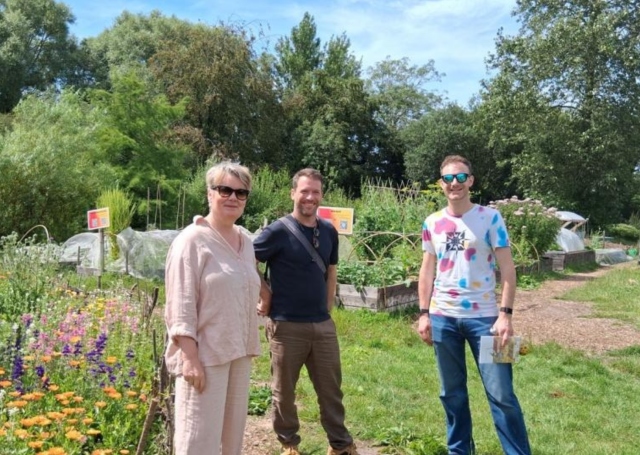
Over two scorching summer days on 5 & 6 July 2026, Dan, along with João Pratas from ACSA in Portugal explored Cork’s urban food system through visits to community gardens, market gardens, food businesses and health-based growing initiatives that form the ecosystem of Cork Food Policy Council. The programme highlighted how food growing can strengthen communities, improve wellbeing and create pathways to more sustainable local food systems.
The replication visit explored how Cork’s FEAST Living Lab connects community food growing, health, social enterprise, local businesses, and emerging City Food Hub infrastructure across neighbourhood and city scales. Through visits to community gardens, market gardens, cafés, markets, and health-campus growing projects, participants examined how food systems can support climate action, wellbeing, social inclusion, local economies, and urban resilience.
Key Findings
Community gardens are much more than food-growing spaces. At Togher, St Luke’s and The Glen, participants saw how community gardens function as social infrastructure, strengthening relationships, improving wellbeing, creating learning opportunities, and fostering community ownership alongside food production.
Different growing models serve different purposes. The visit highlighted a spectrum of approaches, from collective community gardens and neighbourhood growing projects to productive market gardens, grower incubators, training programmes, and social-enterprise horticulture. These models often complement rather than compete with one another.
Access to land, water and safe growing conditions remain major barriers. Experiences at the FEAST Test Site Incubator and St Luke’s Community Garden demonstrated the practical challenges of urban food production, including contaminated soil, irrigation issues, land availability, and climate resilience. Pilot projects provide valuable opportunities to test solutions before significant investment is made.
Partnerships are central to successful urban food systems. Across Cork, strong relationships between local authorities, community organisations, health services, educational institutions, businesses and volunteers have enabled projects to flourish. Examples included collaborations between community gardens and cafés, health campuses and training providers, and community groups and Cork City Council.
Local businesses can play a critical role in food-system development. The partnership between St Luke’s Community Garden and The Hideout Café showed how restaurants and cafés can provide growing space, practical support and a first market for local produce. These relationships help test and develop hyper-local supply chains.
Food growing can support multiple outcomes simultaneously. Projects at St Mary’s Health Campus demonstrated how food production can be combined with skills development, employability, training, social inclusion, health improvement and local economic activity. The campus illustrated that different growing models can coexist within a single site to deliver distinct but complementary objectives.
The City Food Hub should be understood as a network rather than simply a building. Throughout the visit, participants explored the idea of a future City Food Hub as a mechanism for connecting land, growers, community organisations, businesses, markets and public institutions. The concept extends beyond physical infrastructure to encompass relationships, logistics, skills and governance.
Overall Learning
The Cork FEAST Living Lab demonstrates that successful urban food systems are built on relationships as much as infrastructure. Community gardens, market gardens, social enterprises, food businesses and public institutions each contribute different functions within a wider ecosystem. By testing ideas through small-scale pilots, building cross-sector partnerships, and addressing barriers such as access to land and water, Cork is developing a practical model for a more resilient, equitable and sustainable urban food system.